
ACC to PCC: Why More Coaching Hours Aren’t Enough


“I just need to get a few more coaching hours under my belt before I apply for PCC.”
It’s something I’ve heard many times from coaches who are working towards their next ICF credential.
And, of course, coaching experience matters. The ICF has specific experience requirements for each credential, and those hours give coaches valuable opportunities to develop their skills.
But there’s an assumption hidden in that statement that I think is worth exploring.
Does more coaching experience necessarily mean more advanced coaching?
You could accumulate another 500 coaching hours and still be coaching in much the same way.
I’ve worked with coaches who have hundreds of hours of experience and are surprised when we listen to their recordings together. They’re doing many things well, yet their coaching isn’t consistently demonstrating the depth of partnership expected at PCC level.
So what’s missing?
Same competencies, different depth.
ACC and PCC coaches work with the same ICF Core Competencies. The difference lies in how consistently and skilfully those competencies are demonstrated and integrated throughout the coaching conversation.
For example, an ACC-level coach might ask a perfectly good question that helps a client explore their situation. A PCC-level coach might notice something in the client’s language, share that observation and invite the client to explore what it means to them.
Both are coaching. The difference is in the depth of exploration and the partnership demonstrated.
The same applies to listening. At PCC level, we’re looking for a coach who consistently responds to what is emerging for the client, including their emotions, perceptions and shifts in thinking.
And sometimes, the most significant development comes from recognising when to do less.
ACC or PCC? What actually changes?
What does that actually look like in practice?
Drawing on my experience as an MCC, ICF assessor and mentor coach, I’ve put together this infographic to illustrate some of the differences I notice when listening to ACC- and PCC-level coaching.
These aren’t rigid distinctions, and ACC coaches can certainly demonstrate PCC-level coaching behaviours.
What matters is how consistently those behaviours appear and how naturally they’re integrated into the conversation.
Have a look at the infographic. As you read through it, think about your own coaching.
Where do you recognise yourself, and where might there be opportunities to develop?
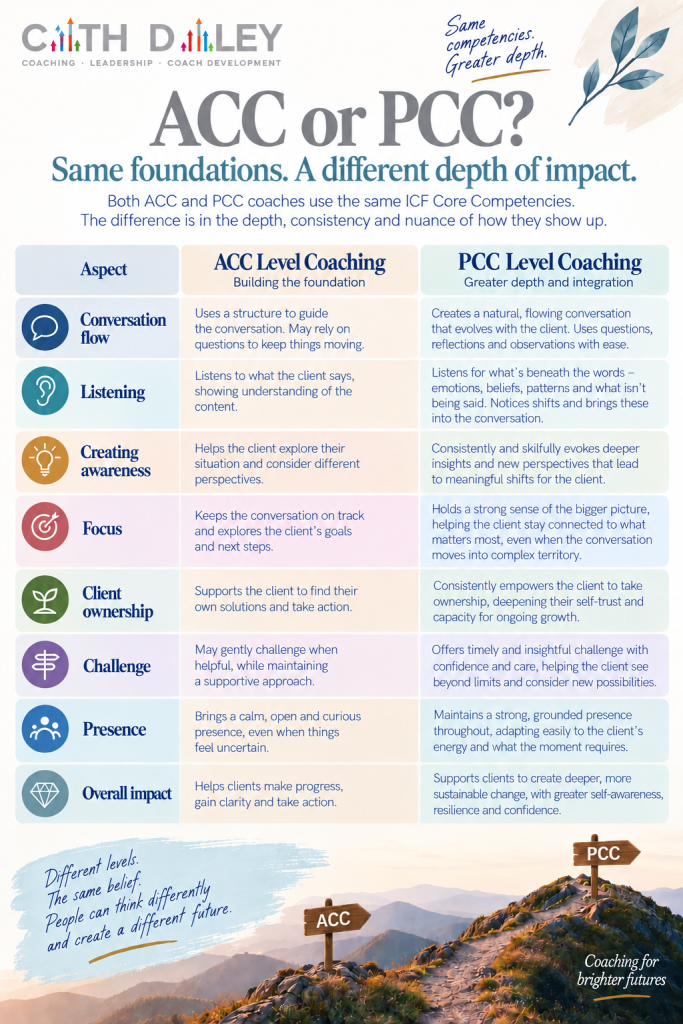
Learning to hear the difference
One of the things I find particularly interesting is that progressing towards PCC often involves recognising what you can let go of, whether that’s the need to ask another question, keep the conversation moving or work quite so hard to help the client.
And that’s where reflective practice and good mentor coaching can make such a difference.
I think that one of the most valuable parts of mentoring is helping coaches develop their ability to recognise what’s actually happening in their coaching conversations.
When we listen to a recording together, we explore where the coach is demonstrating the competencies, what they’re noticing about the client and where their own thinking might be influencing the direction of the conversation.
Sometimes a coach discovers they’re asking another question when the client needs space to think.
Sometimes they’re so focused on achieving the agreed outcome that they miss something important emerging in the conversation.
Sometimes they are making the meaning for the client.
These discoveries can make a considerable difference to their coaching.
Experience alone isn’t development
I believe that reflective practice is essential for coaches who want to develop their mastery.
Simply repeating something doesn’t necessarily make us more skilful at it. We need opportunities to examine our assumptions, recognise our habitual responses and experiment with different ways of being with our clients.
That’s why I place so much emphasis on listening to recordings, reflective practice and developmental feedback in my mentoring programme.
The question I’d invite you to consider is this:
If you listened to a recording of your coaching today and compared it with one from a year ago, what would you notice has genuinely changed?
P.S. Ready to develop your coaching?
If you’re working towards PCC, my ICF Accredited Coach Development & Mentoring Programme gives you the opportunity to explore your coaching through the eyes of an experienced MCC assessor and mentor.
Through individual evaluation sessions, detailed recording feedback and group mentoring, we’ll identify what’s already working and where there’s room to develop.
My next programme starts in November. Find out more about the mentoring programme.
